Monday, October 10, 2016
Wells Fargo Created Fake Accounts for Nearly 10,000 Small Businesses

Thursday, October 6, 2016
How Montgomery County's Bus Rapid Transit Can Alleviate Suburban Poverty
Montgomery County, Maryland, just outside DC, is getting ready to do something that could set a precedent for American suburbs - build a bus rapid transit network. The 82-mile system should offer a huge boost in job access, especially for people without cars.
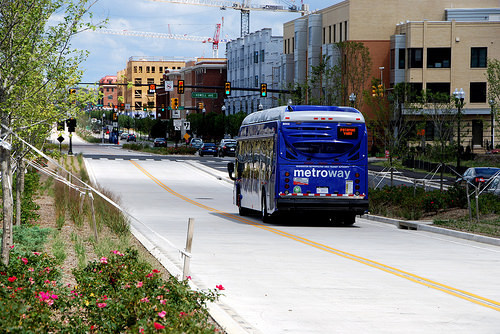
Bus rapid transit can improve job access while reducing household transportation costs in Montgomery County, Maryland. Photo: Beyond DC
Pete Tomao at Greater Greater Washington is especially interested in how the effort might help reduce economic inequality within the county:
Studies have found that as sprawl increases social mobility decreases. This is particularly important on Route 29, where over 12% of households have no access to a vehicle. Digging deeper we see that many folks who live on the Route 29 corridor are also those who can least afford sprawl. 50% of renters on Route 29 earn under 50% of the area median income and a total of 30% of corridor households earn under 50% of AMI.
Further compounding the need for better transit access is Montgomery's uneven recovery from the recession. The Route 29 Corridor in particular was hit hard, median income fell 12% between 2009 and 2014, compare this to 1% in the Bethesda area.
Consider this stat: in 2000, none of the county's census tracts had more than an 18% poverty rate, now there are 12 census tracts exceeding that standard. Much of this new “suburbanization of poverty” is affecting communities in the east far more than those in the west - the Route 29 BRT could help equalize odds in a part of Montgomery that has not seen major transit investments.
Perhaps nothing illustrates the need for affordable transportation on the Route 29 corridor than the number of residents who are rent-burdened, which means they spend more than 30% of their incomes on rent. Looking at data from the US Census we see that 43% of the corridor are renters, 60% of whom are rent burdened.
When you combine housing and transportation costs you see the heavy price of living in a car dependent area. Certain census tracts in Burtonsville show that the average household is spending 71% of their income on rent+[transportation]. That leaves little left over for groceries, healthcare, or savings. The trend continues when looking at other communities along Route 29. In White Oak we see households spending 50% of their income on rent+[transportation] costs, this compares with averages in transit accessible Downtown Silver Spring of 30%-35%. Providing a brt system on Route 29 will allow families to spend more money on essentials like food, and housing.
Elsewhere on the Network today: Rebuilding Place in the Urban Space says it's easy to understand why D.C. Metro ridership has dropped so much: service has declined. And Market Urbanism shares a study that examined what areas of L.A. that were upzoned have in common.
Monday, October 3, 2016
When Commuter Rail Has the Potential to Be Something More
American commuter rail lines tend not to draw many riders. That's what happens when service is limited and the line is set up to shuttle suburban park-and-ride commuters to an urban center in the morning and back home in the evening.
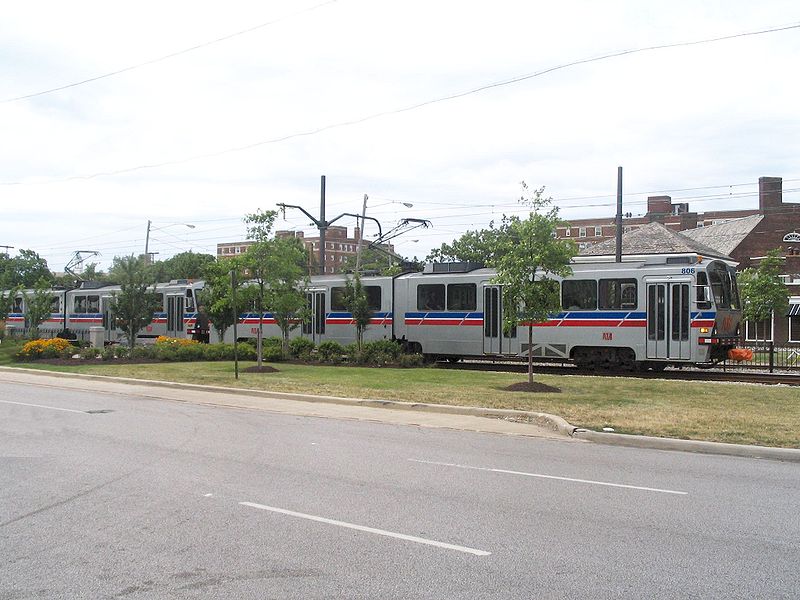
Greater Cleveland RTA's Blue Line could evolve into a more useful service than plain old commuter rail. Photo: Wikipedia
But there's a lot of untapped potential in commuter rail lines. A new report from the Transportation Research Board examines how railways like Cleveland's Blue Line, which extends to the suburb of Shaker Heights, can do a better job of connecting people to the places they need to go, writes Marc Lefkowitz at Green City Blue Lake:
Their analysis of the Blue Line shows that, for the most part, access is limited to those able to drive to it. Except for Shaker Square and downtown, the Blue Line is missing employment options.
“Employment opportunities are rare along this corridor between its terminus at Van Aken Center and Shaker Square, as is pedestrian- or transit-based access to cultural destinations, health care, and major retailers.”
Limited service outside of rush hour is a big drawback. As is the lack of development at station sites. The line is most valuable to one type of customer - a Shaker resident who works downtown.
“The relative lack of these opportunities within this Suburban Commuter Corridor is mitigated by the access to a higher diversity of opportunities available to corridor residents in the CBD. But, transit service is generally limited to commute hours, and the travel time between outlying stations and the CBD is high.”
The Blue Line is a type of “Emerging” corridor where auto-dominated travel patterns and low-density development prevail.
The report, which was sponsored by the Federal Transit Administration, points to Minneapolis's Corridors of Opportunity initiative as a model for involving many people with diverse interests in the effort to promote housing and development around rail stations, Lefkowitz says.
Elsewhere on the Network today: Systemic Failure asks which country has the more market-oriented approach to transportation policy - China or the United States? And Market Urbanism critiques the shaky new defense of sprawl from Joel Kotkin.
Wednesday, September 14, 2016
Deficit Is Surging as Candidates Look to Spend Freely
Valliere was among the first Washington analysts to point out that the deficit started shrinking over four years ago. Now he's early to point out the positive trend has reversed.
Tuesday, September 6, 2016
#USImmigrationLaw: 5 Facts About Illegal Immigration Laws
Sunday, August 21, 2016
Carmelo Anthony Preaches Unity Following Gold Medal Victory
Carmelo Anthony started to tear up as he reflected on his Olympic career on Sunday. The U.S. men's basketball team had just beaten Serbia, 96-66, to win Anthony his third gold medal, an unmatched achievement in men's Olympic basketball, and the weight of the moment started to overwhelm him.
“I know this is the end,” Anthony said. “This is it for me.”
There had been vast interest in how Anthony would responds to winning gold after he authored a July op-ed in the The Guardian in which he said he hoped to use the Olympic stage to make a statement following the shooting deaths of Alton Sterling and Philando Castile. “This is a chance to do something meaningful before an audience of billions,” he wrote at the time, leading many to wonder aloud what he might do.
But on Sunday, Anthony's message was one of unity.
“Despite everything that is going right now in our country, we've got to be united,” he said. “America will be great again, I believe that. We got a lot of work to do, but it's one step at a time.”
After Anthony's comment, the U.S. men's basketball team approached the podium with their arms interlocked, a clear extension of Anthony's call for unity.
Anthony has become one of the most politically outspoken American athletes in recent years. In July, the same day Anthony published his Guardian op-ed, the New York Knicks star stood alongside NBA superstars LeBron James, Chris Paul and Dwyane Wade at the 2016 ESPY Awards, who, together, asked for the country to take a committed stance against gun violence and unnecessary force on the part of police officers.
“The problems are not new. The violence is not new. And the racial divide definitely is not new,” Anthony said. “But the urgency to create change is at an all-time high.”
Olympians John Carlos and Tommie Smith, whose decision to raise their fists at the 1968 Mexico City Olympics remains one of the most iconic moments in Olympics history, have supported Anthony in his recent activism. “He is direct, very direct. And there is truth in [being] direct because there is purpose,” Carlos has said.
Questions will remain about whether the International Olympic Committee's rules scared the team away from a more overtly political statement. The IOC explicitly states in its Olympic Charter that political statements of any sort are not allowed at the games and may result in disqualification. Soon after Carlos and Smith raised their fists, the International Olympic Committee booted the pair from the games and Team USA suspended them.
“I know about that rule,” Anthony told The Undefeated before the Rio Olympics. “We had a rule talk about the do's and the don'ts. What you can do and what you can't do. I know the basics of what I want to do and what I don't want to do.”
-- This feed and its contents are the property of The Huffington Post, and use is subject to our terms. It may be used for personal consumption, but may not be distributed on a website.
Thursday, August 4, 2016
Chris Christie's Transportation Record Is a Bigger Disaster Than Bridgegate
What a fiasco. Six years after New Jersey Governor Chris Christie killed the ARC transit tunnel under the Hudson so he could avoid raising the gas tax, the jig is up. The state has run out of transportation funding anyway.

Photo: Gage Skidmore/Flickr
NJ's Transportation Trust Fund dried up a month ago, bringing a halt to basic infrastructure projects all over the state. Raiding major transit projects, it turns out, is not a sustainable way to fund a transportation system.
But even now, with their backs against the wall, state legislative leaders and reputed Donald Trump manservant Christie are coming up empty, reports Janna Chernetz at Network blog Mobilizing the Region:
It's been one month since the TTF dried up, and the Garden State is still without transportation funding - or even a foreseeable solution. The past six weeks have been rather rocky for the governor and the state's legislative leaders:
- June 23 – The Senate and Assembly TTF reauthorization bills are considered and passed out of committees.
- June 28 – Assembly Speaker Vincent Prieto changes the Assembly's gas tax proposal in a secret midnight meeting with the governor. That version later passes the full Assembly.
- June 30 – Senate President Stephen Sweeney refuses to advance the Assembly proposal, and the fiscal year ends without a resolution to TTF crisis. The TTF officially goes bankrupt, and Christie signs an executive order halting all TTF-funded projects.
- July 22 – Sweeney and Prieto announce a joint plan to renew the TTF.
- July 29 – The Senate Budget Committee considers and passes the Sweeney-Prieto revised plan.
- August 1 – The Senate once again delays a vote on the TTF bill after failing to garner enough votes to guarantee a veto override.
Governor Christie has been - and remains - the biggest obstruction to a solution with his unmerited opposition to a gas tax increase that isn't coupled with unrelated tax cuts. (Where was the call for tax cuts when NJ Transit voted to raise fares last summer?) And this irrational insistence on “tax fairness” has resulted in a complete stalemate in Trenton. It's ironic really, because the purpose of the Transportation Trust Fund, when it was established in 1984, was to remove transportation from the political process.
Elsewhere on the Network today: Denver Urbanism makes the case for “transportation variety” in cities. Streets.mn reports that the departure of a suburban county from a regional transit organization puts plans for bus rapid transit in jeopardy. And Mobility Lab explains how Arlington County transportation engineers were treated to a tour of local bike infrastructure - an exercise everyone hopes will improve road design for cyclists.